
by Jenny Holden, Principal Consultant and Kari Walton, Gender Equality Analyst
Kore Global
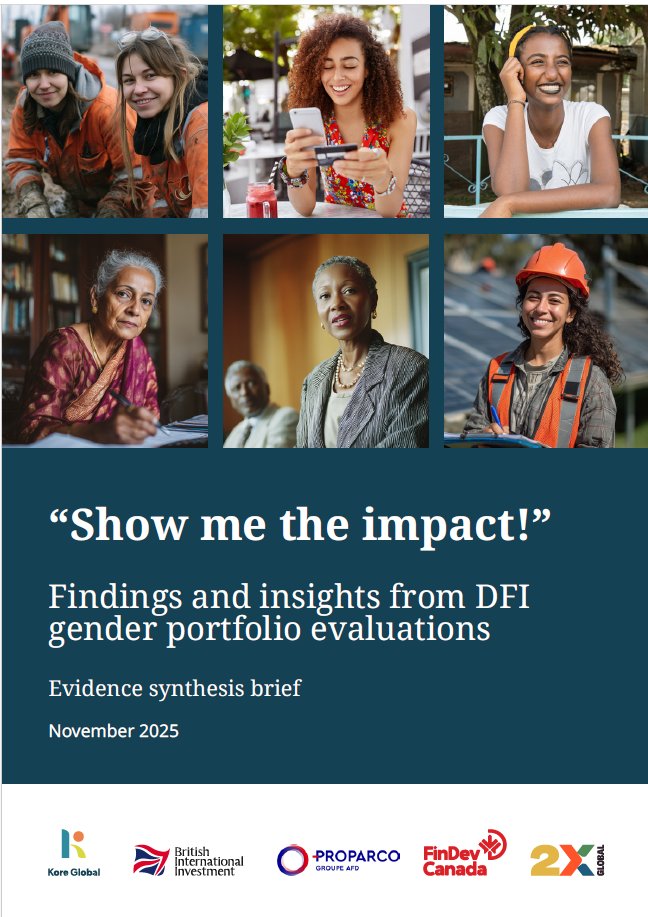
Click the cover image to read the full report.
Since its launch in 2018, the 2X Challenge has mobilised over $33 billion into gender-smart investments globally–built on the assumption that meeting the 2X Criteria delivers real benefits for women.
For the first time, we now have portfolio-wide evidence to test that assumption at scale.
Led by Kore Global, a new synthesis of four independent evaluations—covering 81 unique investments across British International Investment (BII), Proparco, FinDev Canada, and FMO’s portfolios—offers the clearest picture yet of how the 2X Criteria play out in practice. Here is what we found.
What the evidence shows
The synthesis reveals three powerful insights that deepen our understanding of what drives gender outcomes across DFI portfolios.
1. The 2X Criteria are a reliable signal—but only a starting point.
Across the 81 investments, every top-performing investment with regard to gender outcomes was 2X-qualified, typically under multiple 2X Criteria. This isn’t a coincidence. DFIs are using the 2X framework to successfully identify investments with the structures, commitments, and potential to drive real impact.
“Across the 81 investments, every top-performing investment with regard to gender outcomes was 2X-qualified, typically under multiple 2X Criteria. This isn’t a coincidence.”
But qualification alone doesn’t guarantee results. The data also shows variation within 2X portfolios, revealing that meeting the 2X Criteria thresholds at investment doesn’t necessarily ensure sustained, comprehensive outcomes for women. For this reason, the 2X Criteria should be understood as the floor, not the ceiling—a foundation that must be reinforced through intentional follow-through, technical assistance, and active monitoring.
2. Leadership diversity is a game-changer.
One finding in particular stands out above all others: gender-diverse leadership is one of the most powerful predictors of gender outcomes.
All five of the evaluation’s top-performing investments qualified under the 2X Leadership Criterion. These firms didn’t just have women in the room—they had women in senior management and on boards or investment committees, with real decision-making power. And the results showed everywhere: more inclusive workplace cultures, stronger gender targets, better use of sex-disaggregated data, and more innovative solutions tailored to women’s needs.
Yet leadership diversity remains rare, especially in male-dominated sectors like energy, infrastructure, and forestry. Many investments with strong female workforce participation had almost no women in leadership. This represents a significant missed opportunity; supporting women’s pathways into leadership could unlock broader, deeper impact across entire portfolios.
3. Intentionality matters more than sector or geography.
“All five of the evaluation’s top-performing investments qualified under the 2X Leadership Criterion. These firms didn’t just have women in the room—they had women in senior management and on boards or investment committees, with real decision-making power.”
The highest-performing investments when it comes to gender outcomes weren’t clustered in specific regions or industries. Rather, top performers across the 81 investments shared four common enablers:
Dedicated resources and structures for gender integration
Systems to collect and use sex-disaggregated data
Clear understanding of local gender contexts and business opportunities
Strong leadership buy-in and values around gender equality
Context shaped what success looked like—from engaging mothers-in-law in South Asia to providing safe transport for women workers—but outcomes were determined by how deliberately clients embedded gender-smart practices. This matters because it means gender impact isn’t predetermined by location or sector, but by choices that DFIs can actively support.
What this means for the field
This synthesis does more than validate the 2X Criteria. It demonstrates that gender-lens investing, done well, delivers measurable development outcomes for women. It shows which levers work, which are underused, and where the greatest opportunities lie.
“This synthesis does more than validate the 2X Criteria. It demonstrates that gender-lens investing, done well, delivers measurable development outcomes for women. It shows which levers work, which are underused, and where the greatest opportunities lie.”
This synthesis arrives at a pivotal moment. The 2X Criteria were updated in 2024 to make qualifications even more impactful. Key changes include new Governance & Accountability requirements, strengthening the connection between Employment and Leadership Criteria, and introducing a Supply Chain Criterion. These enhancements align with evidence from the synthesis and point to even greater potential for the updated 2X Criteria to deliver meaningful outcomes for women.
The 2X Criteria framework has proven itself as the global standard for gender-smart investing. Now the challenge—and opportunity—is to move from qualification to transformation, from thresholds to sustained impact, from good intentions to outcomes that women can feel. At Kore Global, we see this shift happening across the partners we work with, and we are committed to helping investors, fund managers, and enterprises deepen their gender impact through evidence-driven insights, practical tools, and strategic support. As the field evolves, we look forward to continuing to collaborate with partners who are ready to push beyond compliance and drive real, lasting change.