
Building Women’s Financial Resilience Through a Digital Savings-Led Banking Model
About
Building formal savings is a key component of developing financial resilience. Savings help families weather economic storms and combat inflation. They can be especially important for women, who are more likely than men to have to rely on friends and family during emergencies. Savings are also good for banks’ resilience, as they help them grow retail deposits which are vital for their business health.
Unfortunately, only 27% of adults in India save regularly in formal accounts, according to the 2024 World Bank Global Findex. While the country has made remarkable progress in expanding financial access, with 89% of Indian adults now holding a bank account, 14% of accounts are inactive, a rate more than double the global average for low- and middle-income economies. Even more concerning, 70% of adults in India find it very difficult or impossible to access emergency funds within a month when faced with financial shocks.
Type of actor
Investment fund (DWM) and investee (Suryoday Small Finance Bank)
Investment type
Equity
Operates from
India
Sectors
Financial Services, Fintech
Key Partners
To help make savings more accessible for low-income households in India, Developing World Markets (DWM) partnered with Suryoday Small Finance Bank and Saathi Money to launch the Digital Savings and Resilience Program. Our aim is to show how technology can transform the way small finance banks in India – which were originally set up with the mandate of financial inclusion - can support resilience within low-income households. The program uses digital innovation, behavioral science and group-based savings models to reach underserved communities at scale.
Approach
Bridging the gap between financial access and financial resilience requires reimagining how banks engage with customers as savers, not just borrowers. In DWM’s experience across 40 countries, we’ve seen that when microfinance institutions become banks, their strategies often prioritise risk avoidance over building real financial security for customers. Traditional branch-led approaches, focused on attracting high-value accounts, haven’t worked for lower-income groups.
Recognising these limitations—especially for India’s urban poor—the pilot program tested a new approach built on three core principles:
Customer-centered product design: Co-creating financial products with women microentrepreneurs to ensure offerings match their real needs and behaviors.
Behavioral economics: Using goal setting, peer support, incentives and gentle nudges to encourage consistent saving habits.
Digital engagement: Making it easy and accessible to save formally through mobile-friendly, user-centric platforms.
Designing a digital group savings experience
Through focus groups and ethnographic research, we learned about the preferences and needs of the women micro-entrepreneurs. Despite owning bank accounts, many women rarely used them. Applications were complicated, products were not user-friendly, and account services often felt disconnected from their financial realities.
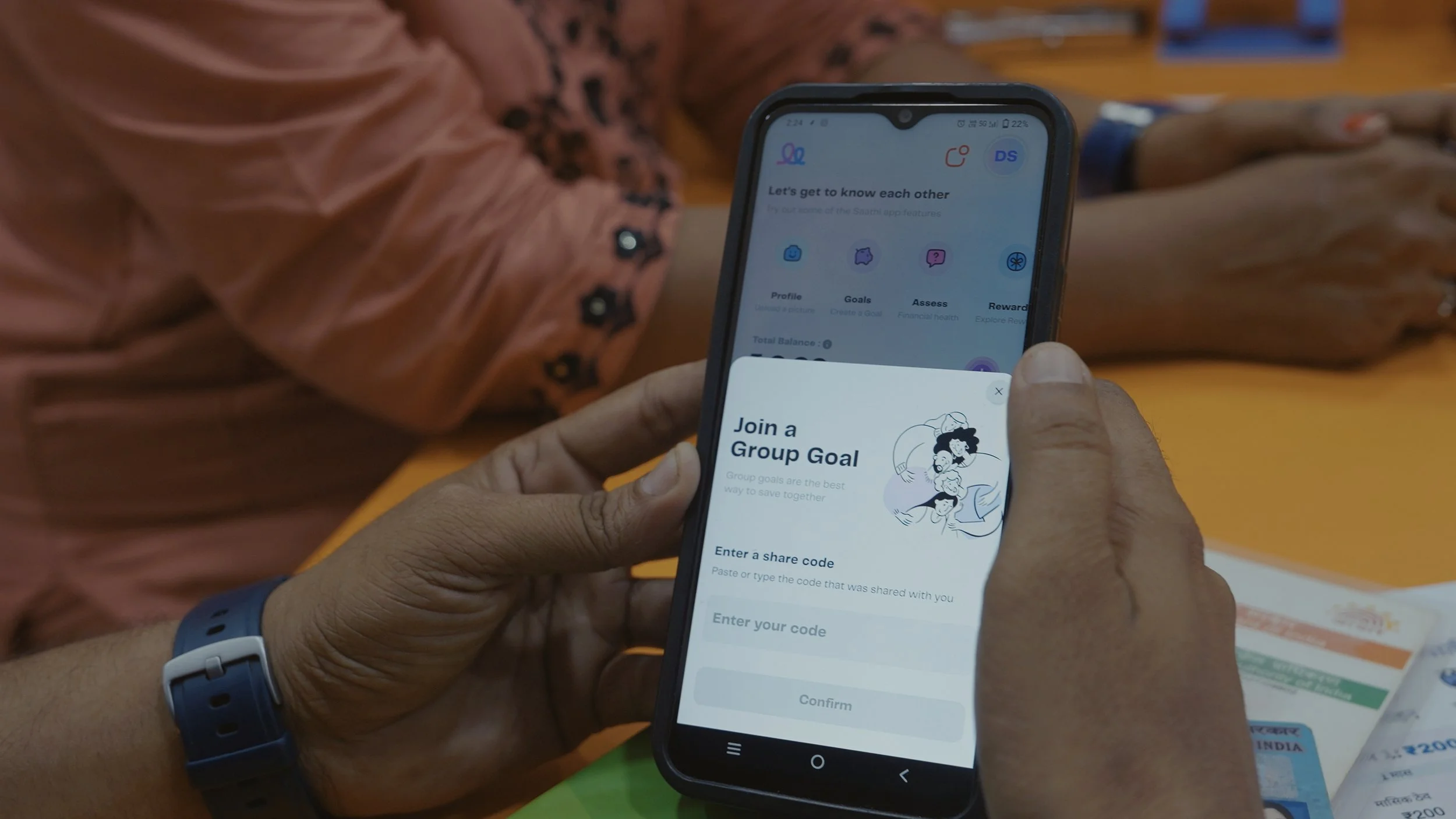
To reduce these barriers to access and adoption, we designed a digital group savings experience that mirrored the preferences of how women save informally. By promoting a group goal, the application interface encouraged members who had taken existing loans as groups to save together and invite their friends and family to save with them, each in their respective accounts. Each member could select a specific savings plan, set their goals and choose whether to save weekly or monthly based on their preferences. Their Relationship Officer assisted them throughout the process and invited them to get support from their peers.
Our design approach took advantage of the psychological nature of financial behavior. In addition to peer support and goal setting, gamified rewards provided incentives to save and gentle nudges helped remind members to stick to their goals.
We also made it easy for members to deposit funds through a combination of digital payments and doorstop cash collection during their regular loan repayment process. There were no penalties or charges for missing a savings installment, and they could withdraw their money at any time. These features built the women’s confidence and trust in using the platform to save.
Impact
The pilot demonstrated that digital solutions designed with customers in mind and inspired by familiar informal practices can dramatically shift saving behaviors. For many women who participated, this represented the first time saving digitally. Additionally, women who participated wanted to save $50 on average over the course of a 12-month period — a potential tenfold increase from existing average balances of $5. After six months, 75% of those that activated their plan are on track to reach their goals, and the average savings balance has increased from $5 to $20 for the initial cohort.
Early qualitative feedback gathered by Saathi Money has shown increased confidence in using digital banking services, thanks to peer support and assisted onboarding. For Suryoday Bank, the pilot offered a cost-effective way to attract new customers and mobilise deposits through a digital-first, community-based model.
Key Takeaways
By combining trusted community savings practices with the security and convenience of digital banking, this approach offers a scalable way to boost savings and financial capability - especially for women. If small finance banks can successfully mobilise small, digital savings from their existing communities, they’ll not only help millions of low-income households build resilience, but also strengthen their own funding base and long-term sustainability. It’s a win-win.
The success of this pilot shows what’s possible - and signals a call to action for financial institutions, investors and ecosystem partners to bridge the gap between access and resilience, unlocking a more inclusive and secure financial future for all.
What’s Next?
We are now scaling up our program to help Suryoday Bank deepen their presence in underserved urban areas where low-income families reside. Additionally, we are actively partnering up with other financial institutions in Asia and Africa, along with various social enterprises, digital platforms and NGOs to explore strategies to help their communities to break the cycle of financial vulnerability.
Over the next five years, the partnership between DWM and Saathi Money aims to reach 4 to 5 million low-income households, accelerating pathways to financial security and inclusion for women from low-income households through blended financing models.
This case study was originally published by FinEquity on the FinDev Gateway blog.