
Assumptions vs. Realities in the Gender-Clean Energy Nexus
Evidence for Better Investment In Women's Economic Empowerment
by Elise Montano, Caribou and Shell Foundation
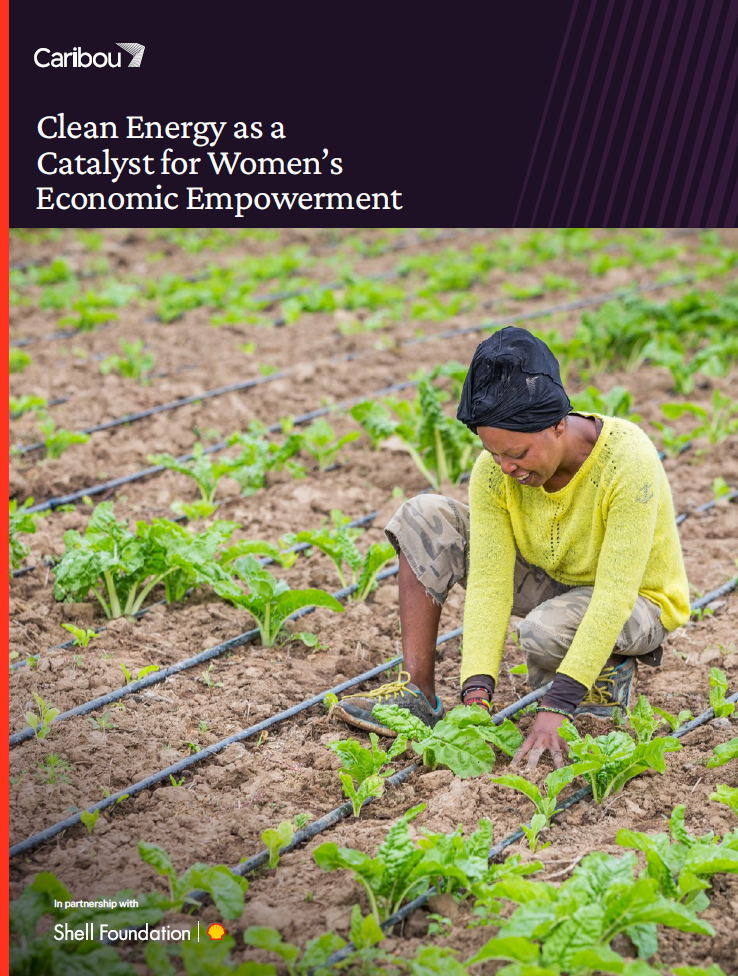
Clean energy is an underutilised investment strategy available to funders and investors serious about women's economic empowerment. A new synthesis of more than 115 studies, produced by Caribou and delivered in partnership with Value for Women, with support from the Shell Foundation, FCDO, and Gates Foundation, shows that, across asset types, geographies, and women’s diverse social and economic roles, clean energy assets consistently generate measurable returns for women.
These findings should shape how investors prioritise capital in the growing gender–clean energy nexus.
While the climate and health benefits of clean energy assets are well acknowledged, the impact on women’s incomes has remained fragmented for investors. Less than 2% of climate financing is gender-responsive, and for much of the past decade, the gender–clean energy nexus has been treated as a hypothesis: clean energy assets save women time, and time savings should translate into income.
This new report, Clean Energy as a Catalyst for Women’s Economic Empowerment moves beyond that assumption. From Caribou’s perspective, the shift is not just in the strength of the hypothesis, but in the consistency of evidence. We can now say with confidence not only that clean energy can improve women’s incomes, but under what conditions, and where current investment approaches are likely to fall short.
While evidence is context driven, a clear pattern of positive impacts on productivity and incomes for women emerges:
In Ethiopia, solar-powered irrigation boosted women's farm incomes by 18%.
In Benin, 75% of women using solar irrigation reported increased productivity, and 70% of women farmers raised their income by US$250 per year.
In India, Zero-Energy Cool Chambers (ZECCs) reduced post-harvest losses by 30% to 35%, ensuring that increased production reaches the market rather than spoiling in the field.
In Kenya, solar milk chillers more than doubled the incomes of predominantly female smallholder dairy farmers by significantly reducing waste and losses.
In Tanzania, electrification enabled women entrepreneurs to generate an average of US$364–676 in new revenue per year for both new and established micro-businesses.
Taken together, these examples show that when clean energy assets are directly linked to income-generating activities, returns for women are both measurable and repeatable. But while these returns are substantial, they don’t all occur through the same pathway. For funders and investors, this raises a more practical question: where are current assumptions about impact no longer holding up?
The nuance for investors: Time savings create income for women only when specific conditions are met
One of the most consistent patterns that we observed was that clean energy assets reach women through two fundamentally different pathways, and this distinction matters for investment design.
The first pathway runs through time savings. Assets used within households, like clean cookstoves or solar lighting, typically free women and girls from the drudgery of collecting firewood. The pathway relies on the dominant assumption in the sector that women can use that time, typically between 15 minutes and 1.5 hours per day, to engage in income-generating activities.
“Without relevant vocational skills, access to markets, and agency over how they spend their time, a woman’s ability to apply any time savings from clean energy to income-generating activities is limited.
The mechanism is real, but its potential is conditional, not automatic.
Realising this potential requires specific conditions that most investments don’t deliberately create or nurture, but the investment can set up the preconditions for wider economic transformation within a well-crafted design.”
However, new forthcoming primary research from Duke University and Shell Foundation challenges this assumption. Evidence from across Kenya, Nigeria, and India shows that time savings are often fragmented throughout the day, rather than appearing as a single, usable chunk. Without relevant vocational skills, access to markets, and agency over how they spend their time, a woman’s ability to apply any time savings from clean energy to income-generating activities is limited. The mechanism is real, but its potential is conditional, not automatic. Realising this potential requires specific conditions that most investments don’t deliberately create or nurture, but the investment can set up the preconditions for wider economic transformation within a well-crafted design.
The second pathway is more direct. ‘Productive-use assets’ are clean energy technologies used in income-earning settings, such as on farms or within micro-businesses. Examples include solar-powered water pumps and improved, energy-efficient stoves. The benefits women derive from a clean energy asset depend entirely on who the woman is, what role she plays, and the asset in question; however, they typically reduce waste or spoilage, increase productivity, or lower input costs. Across a range of contexts and technologies, evidence consistently shows that, where women are already earning an income, these assets directly increase either revenue, profitability, or both.
The financial returns from these assets are clearer and more measurable, as they work through economic efficiency rather than time reallocation. Financial modelling produced by Caribou for this report confirms these findings.Productive-use assets in income-generating contexts consistently show stronger financial returns.
Productive-use technologies placed with women’s roles in mind minimise the risk of male capture of benefits
When clean energy assets prove economically valuable, there is a significant risk that technologies that expand women’s productivity can shift into male hands when their value becomes visible. In many agricultural value chains, men control technology adoption decisions even where women perform the majority of the labor. The same solar irrigation system that expands a woman's productivity can be taken over by men once it becomes more financially appealing, particularly when assets are registered in men’s names or governed by male-dominated cooperatives.
Gains are most likely to reach women in contexts where they retain decision-making authority over productive assets. Evidence from agricultural value chains across India, Kenya, and Nigeria shows that technologies introduced at post-harvest and processing stages (such as drying, milling, storage, and sorting) are more likely to retain gains for women because women already control those stages. In contrast, new research (forthcoming) from Shell Foundation and Sattva Consulting finds that assets introduced at production stages, such as irrigation, pruning, or mechanised land preparation, occur where men are more likely to control decisions and asset use.
“Gains are most likely to reach women in contexts where they retain decision-making authority over productive assets.
Evidence from agricultural value chains across India, Kenya, and Nigeria shows that technologies introduced at post-harvest and processing stages (such as drying, milling, storage, and sorting) are more likely to retain gains for women because women already control those stages.”
This dynamic is not a reason to avoid productive-use investments. It is a reason to treat asset placement, registration, governance design, and women's formal ownership as core investment conditions rather than complementary add-ons. Interventions that do not specify how women will retain control over assets and income should be considered higher risk.
Closing the investment gap: Using the evidence to contribute to women’s economic empowerment
Closing the investment gap for women calls for two fundamental shifts: directing more capital towards assets that support women, and rethinking how those investments are structured from the outset. Understanding the different pathways by which clean energy assets impact women is the first step in designing investments that generate income.
In future blogs, we will explore the ARISE framework, a tool Caribou developed to identify enabling conditions that affect the likelihood that an investment will have a positive impact on women’s economic empowerment, alongside findings from financial modelling and implications for designing financing for women.
The sector has spent years building the evidence base around clean energy and women’s economic empowerment. This new synthesis provides investors with clear insights into what is possible and what is needed to close the gap for women.
Women represent a significant number of smallholder farmers, micro-entrepreneurs, and household energy managers in the communities that clean energy programs target. They are also systematically underserved by investment that is not designed with their economic roles, constraints, and opportunities in mind. Where needs are unmet, and the evidence now shows how to meet them, the implication is straightforward: capital not designed around these conditions is unlikely to deliver the returns it targets.
If you are designing or funding clean energy investments and want to understand how they fit into the evidence base, get in touch with Caribou.